


Octel Bromine Works, Anglesey. 2022

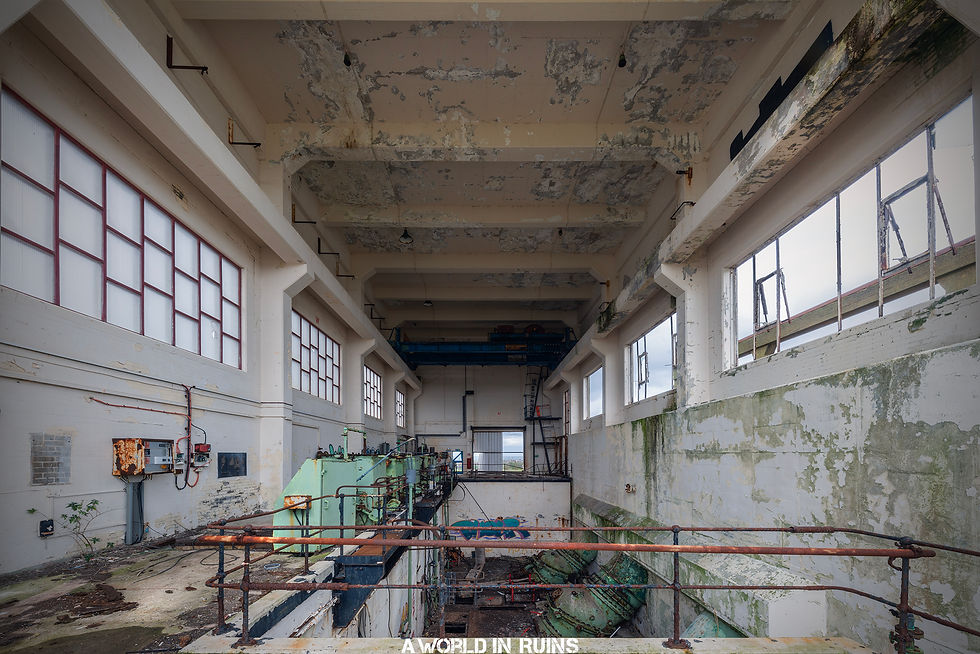


The long abandoned Octel Bromine Works remains in its decayed state along the dramatic Anglesey coastline and is a reminder of the areas rich industrial past as the huge plant fades into the mist - its purpose exhausted.
The plant was built in 1953 to extract bromine from seawater and turn it into an additive for petrol engine. The geographical location was critical in the site being built here as it was able to take advantage of the sea water in the area. Of critical importance was for the seawater from which the bromine is extracted to be as clean as possible as well as being able to be replenished with fresh seawater quickly whilst being warmed by the Gulf Stream.
At the time, petrol used in road vehicles contained lead. Engine “knocking” was a common problem, when the mixture of air and fuel didn’t burn efficiently with each detonation. This could damage engine cylinders over time. The additive produced at Octel reduced knocking and improved engine efficiency.
This site extracted bromine from sea water using sulphuric acid to help change and concentrate the bromide in the sea water to liquid bromine. This was then reacted with ethylene to produce Dibromoethane which was key component of leaded petrol.
As the health effects of lead in vehicle exhaust gases became better understood, unleaded petrol was developed. It was introduced to UK filling stations in the 1980s, and leaded petrol was later phased out. As demand for anti-knock additive reduced, the Octel factory diversified into other bromine products and was taken over by Great Lakes Chemical Corporation. In 2003, the corporation decided to close the works with the loss of more than 100 jobs.
Attempts were made by politicians in Cardiff to save the site from closure but this proved to be in vain and consequently - after 50 years in production - bromine derived chemicals from the sea water at Amlwch came to an end.
This brought to an end a history of chemical production in the area which commenced in the 1760's with the Parys Mountain copper mine which had been an early producer of first element sulphur then sulphuric acid as by products of the production of Copper ore.
In 1994, a huge fire started at the Octel plant and five workers required hospital treatment. As a result of the fire, a fifteen mile exclusion zone was declared around the island’s north coast after rubber sheeting in one of the plant’s towers caught fire. A decision to close the works was taken in 2003 with the plant was shutting completely inn 2005 prior to decontamination of the site for future purposes.